Your horse pins his ears when you tighten the girth. He walks away from the mounting block. He suddenly doesn’t want to move forward. Maybe he bucks when you ask for the canter, refuses a jump he normally enjoys, or simply feels reluctant, sour, or “stuck.”
It can be tempting to think: He’s being lazy. She’s testing me. He just doesn’t want to work today. But before assuming a behavioral or training problem, there is another question worth asking: Could it be the saddle?
Horses Don’t Have Many Ways to Tell Us Something Hurts
A horse can’t tell us that the saddle feels fine at the walk but pinches when his back lifts in the trot. He can’t explain that pressure behind his shoulder is restricting his movement, or that the saddle shifts and becomes uncomfortable when a rider’s weight is added. Instead, horses communicate through behavior and movement. And sometimes what looks like resistance is actually an attempt to avoid discomfort. Signs can be obvious, but they can also be surprisingly subtle:
- Walking away when you approach with the saddle
- Pinning the ears during saddling or girthing
- Biting or threatening to bite
- Difficulty standing at the mounting block
- Hollowing or dropping the back when mounted
- Reluctance to move forward
- Shortened stride
- Difficulty bending in one direction
- Trouble picking up or maintaining a particular lead
- Bucking, crow-hopping, rearing, or bolting
- Refusing jumps
- Becoming increasingly “girthy”
- Tail swishing or ear pinning during work
- Unexplained changes in attitude or performance
- Sensitivity when the back is brushed or touched
None of these behaviors automatically means the saddle is the problem. Dental issues, hoof pain, ulcers, arthritis, muscle soreness, rider imbalance, training problems, and many other factors can produce similar signs. But saddle fit deserves to be on the list of things we investigate.
BEHAVIOR IS INFORMATION A sudden change in willingness, movement, or attitude deserves investigation before it is automatically treated as disobedience.
A Saddle Has to Fit the Horse — Not Just Look Like It Fits
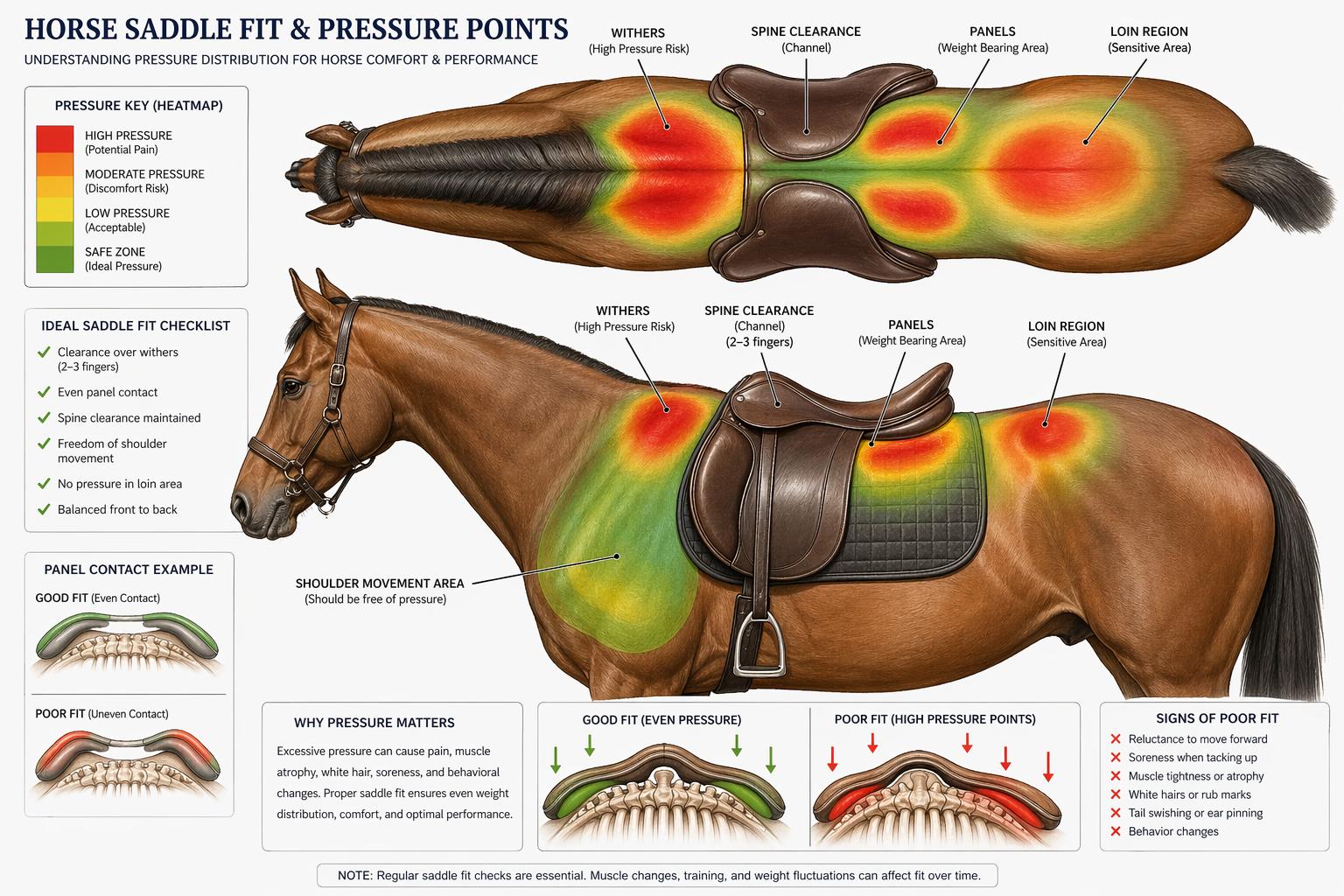
Saddle fit is much more complicated than whether the saddle appears to sit nicely on the horse’s back. A properly fitted saddle should distribute the rider’s weight over an appropriate area without creating excessive pressure points. It should provide adequate clearance for the spine and withers, allow freedom around the shoulder, remain balanced, and stay reasonably stable during movement. And that fit needs to be evaluated with the horse in motion and with a rider aboard, not simply while the horse is standing in the aisle. A saddle that looks acceptable on a stationary horse can behave very differently once the horse begins moving. When a horse lifts his back, engages his abdominal muscles, reaches underneath himself, bends through his body, and moves his shoulders, the relationship between horse and saddle changes. Then add the weight and balance of the rider. That is when some fitting problems become much more apparent.
Saddle fit involves much more than wither clearance. Balance, panel contact, tree shape, spinal clearance, shoulder freedom and stability all contribute to how the saddle functions.
Quick Saddle-Fit Warning Signs
You don’t have to wait for dramatic behavior to start paying attention. Your horse’s back, coat, saddle pad, and behavior can all provide useful clues.
Look at your horse after you ride.
Before you groom everything away, take thirty seconds to examine the saddle area. Watch for:
- Rubbed or broken hair, particularly when it repeatedly occurs in the same place
- Ruffled or disturbed hair beneath the saddle
- New white hairs developing in the saddle area
- Swelling, bumps, heat, or tenderness after riding
- Areas that are sore to the touch
- Flinching, dipping, or tightening of the back muscles when touched or groomed
- Dry patches surrounded by otherwise sweaty areas
- Noticeably uneven sweat patterns
- Repeatedly uneven marks on the saddle pad
- Rubbing or hair loss near the withers, behind the shoulder, or toward the back of the saddle
What Can White Hairs Tell Us?
New white hairs appearing in a concentrated area underneath the saddle deserve attention. Damage or excessive pressure to the skin and hair follicles can sometimes result in hair growing back white. However, white hairs are evidence of previous tissue or follicle injury—not proof that the horse’s current saddle caused it. If new white hairs begin appearing beneath the saddle, particularly alongside tenderness, rubbing or behavioral changes, it is worth investigating.
What About Sweat Marks?
Sweat patterns can provide useful information, but they should not be treated as a stand-alone saddle-fitting test. A perfectly symmetrical sweat mark does not guarantee that a saddle fits correctly, and an irregular sweat pattern does not automatically mean that it doesn’t. What matters more is the complete picture. Consistent dry spots, dramatically uneven sweating, or the same unusual pattern appearing ride after ride become more meaningful when they occur alongside:
- Back soreness
- Rubbing
- Hair changes
- Saddle movement
- Shortened stride
- Behavioral changes
- Reluctance to move forward
Think of sweat patterns as one piece of the puzzle rather than the entire answer. Sweat patterns can provide clues about saddle contact and pressure, but should always be interpreted alongside the horse’s movement, behavior, back condition and the saddle itself. And don’t just look at the horse. Turn your saddle pad over. Compare the two sides. Look for repeated differences in dirt, sweat, pressure marks or hair. Again, one unusual mark doesn’t diagnose a saddle problem—but patterns that consistently return are worth noticing.
Watch the Saddle While You Ride
Some clues aren’t visible until the horse is moving. Watch for:
- A saddle that consistently slips to one side
- Excessive rocking or movement
- The back of the saddle repeatedly lifting
- A saddle creeping forward onto the shoulders
- A saddle consistently sliding backward
- Reduced wither clearance once the rider is mounted
- The rider continually feeling tipped forward or backward
- A horse who moves noticeably better in a different saddle
A saddle shouldn’t have to be completely stationary, but excessive or consistent movement can indicate that something about the horse-saddle-rider combination needs evaluation.
The Shoulder Needs Room to Move
One area that deserves particular attention is the horse’s shoulder. The shoulder blade moves as the horse extends the forelimb. If the saddle interferes with that movement, the horse may compensate by shortening his stride or changing the way he uses his body. A horse that once moved freely may begin to feel increasingly reluctant to go forward. [DIAGRAM: Horse’s shoulder blade at rest and during extension, with the front of the saddle shown in relation to the scapula.] Caption: The horse’s shoulder blade moves during every stride. Saddle placement and fit need to allow the shoulder to function freely. This can create an unfortunate cycle. The rider feels that the horse is behind the leg and uses stronger aids. The horse experiences more discomfort and becomes more resistant. The rider concludes that the horse is becoming difficult and applies still more pressure. Meanwhile, the horse may have been trying to communicate the same thing all along: Moving forward hurts.
Too Narrow Isn’t the Only Problem
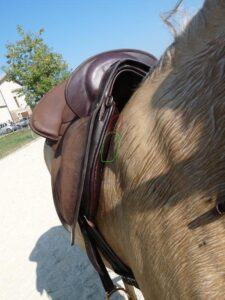
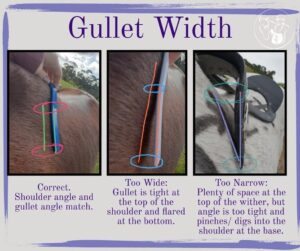
Many riders recognize that a saddle can be too narrow. But too wide can create problems, too. Depending on the horse and saddle, an unsuitable fit can contribute to instability, excessive movement, uneven pressure, bridging, rocking, tipping or concentrated pressure in particular areas of the back. This is also why simply putting your fingers underneath the pommel and checking the amount of wither clearance isn’t enough to determine whether a saddle fits.
More clearance isn’t necessarily better. A saddle that is too narrow or too wide can both create undesirable pressure and balance. Saddle fit involves the entire relationship among the saddle, the horse’s back, the rider and the way all three interact in motion.
Your Horse Can Change — Even When Your Saddle Doesn’t
One of the most important things to understand about saddle fit is this: A saddle that fit your horse last year may not fit your horse today. Horses change shape. Their backs can change because of:
- Age
- Weight gain or loss
- Changes in fitness
- Muscle development
- Time off
- Rehabilitation
- Changes in workload
- Changes in topline
- Seasonal changes in body condition
A young horse developing muscle may change considerably. A horse returning from several months off may have a very different topline than he did when he was in full work. Even a well-fitted saddle should therefore be reassessed periodically. Saddle fit isn’t necessarily a one-time purchase decision. It is something that should be monitored throughout the horse’s life.
Look at the Rider, Too
There is another part of saddle fitting that sometimes gets overlooked: The saddle needs to accommodate the rider as well as the horse. A saddle can fit the horse reasonably well and still create problems if it doesn’t appropriately accommodate the rider. Seat size, flap position, balance, stirrup placement and the rider’s position can all influence how weight is transmitted through the saddle. If a saddle consistently puts the rider behind or ahead of the horse’s center of balance, that can affect both the rider’s stability and the pressure experienced by the horse. Horse, saddle and rider function as a system. Evaluating only one part of that system can miss important information.
Can I Fix It With a Thicker Saddle Pad?
Not necessarily. Pads can be useful tools, and therapeutic, corrective or shimmed pads may help address particular fitting situations when selected appropriately. But simply adding more padding does not necessarily make an unsuitable saddle comfortable. Think about putting on a pair of shoes that are already too small and then adding thicker socks. More padding isn’t always more comfortable. In some circumstances, putting a thick pad underneath an already-too-narrow saddle can actually reduce the available space further. The goal shouldn’t be to pile enough material underneath a saddle to make it appear to work. The goal is appropriate pressure distribution, stability, clearance, balance and freedom of movement.
Pay Attention When Your Horse Changes
Perhaps the most important lesson is simply to notice. If your normally willing horse suddenly starts walking away from the mounting block, don’t automatically label it disobedience. If your horse begins pinning his ears when you saddle him, investigate. If his stride suddenly becomes shorter, ask why. If he stops wanting to canter, investigate. If a previously enthusiastic horse becomes increasingly reluctant to work, pay attention. Behavior is information. It doesn’t always tell us exactly what is wrong. But it tells us that something may deserve a closer look.
When It’s Time to Call a Saddle Fitter
Saddle fitting is specialized work. If you suspect a problem—or simply haven’t had your saddle evaluated in some time—a knowledgeable professional can assess things that are difficult for the rider to evaluate alone. Ideally, a saddle-fitting assessment should consider:
- The horse’s conformation and back
- The saddle without a rider
- The saddle with the rider mounted
- Balance and clearance
- Panel contact
- Stability
- Shoulder freedom
- The horse moving under saddle
- The rider’s position and balance
- The horse’s response before and after any adjustments
And remember: not all saddle fitting services are the same. When choosing a fitter, ask about their education, training and qualifications. Ask whether they are independent or represent particular saddle manufacturers. Find out whether they will evaluate a saddle you already own or primarily fit saddles they sell. Most importantly, ask whether they evaluate the horse in motion, under saddle, with you riding. A saddle-fitting appointment shouldn’t automatically be a saddle-shopping appointment. Sometimes the saddle needs replacing. Sometimes it can be adjusted. Sometimes a different pad or shimming arrangement may be appropriate. And sometimes the saddle isn’t the source of the problem at all. The purpose of the evaluation is to find out.
Hudson Valley Saddle-Fitting Resources
For riders in the Hudson Valley and surrounding areas, there are a number of saddle-fitting professionals who either work locally or advertise travel to our region. Some resources to investigate include: Shipley Equine Services LLC — Carmel, New York Offers independent saddle-fitting services as well as equine bodywork. Its proximity to Dutchess County may make it particularly convenient for riders in the eastern Hudson Valley. Dutchess Bridle & Saddle, LLC — Montague, New Jersey Offers mobile saddle fitting and works with both English and Western saddles. The company states that it will evaluate existing saddles, including saddles purchased elsewhere. Synergy Saddle Fit — Delanson, New York Provides professional saddle-fitting services and specifically lists the Hudson Valley among its New York service areas. RER Saddlery / Heather Dostal Provides saddle-fitting services throughout the Northeast and advertises travel to the Hudson Valley. Services include existing-saddle assessments and certain on-site saddle adjustments. EQ Saddle Science / Brianne Valentino Provides saddle-fitting services in the Hudson Valley and surrounding region.
This list is provided as a starting point for horse owners seeking saddle-fitting resources. Inclusion does not constitute an endorsement by Carlette Farm. Riders should independently verify each fitter’s current service area, qualifications, methods and availability.
Saddle Fit May Be Only Part of the Picture
It is equally important not to blame every performance problem on the saddle. Back pain and behavioral changes can have many possible causes. If a horse shows significant or sudden discomfort, your veterinarian should be part of the conversation. Depending on the situation, your farrier and other qualified equine professionals may also provide important information. The saddle is one piece of a much larger biomechanical system. Feet, teeth, joints, muscles, conditioning, rider balance, tack, training and underlying medical conditions can all affect how a horse feels and moves. The objective isn’t to decide in advance that the saddle is responsible. The objective is to listen when the horse tells us that something may be wrong.
Before You Call It a Training Problem, Rule Out Discomfort
Most of us want our horses to enjoy their work. That doesn’t mean a horse will never have an opinion, test a boundary, or need thoughtful training. But when behavior changes—particularly when that behavior occurs around saddling, mounting or being asked to move forward—discomfort should be considered before escalating pressure or correction. A reluctant horse isn’t necessarily a lazy horse. A “girthy” horse isn’t necessarily a difficult horse. A horse who suddenly doesn’t want to canter isn’t necessarily being stubborn. And a horse who suddenly doesn’t want to go forward may be telling us something important. So the next time your horse seems to be saying: “I don’t want to.” Before answering with “You have to,” consider asking another question: “Why?” Sometimes, the answer may be right underneath you.
At Carlette Farm, we believe exceptional care begins with paying attention to the individual horse. Changes in behavior, movement and attitude are information—and our horses depend on us to listen.