Rider size, horse size, saddle fit—and the question we sometimes don’t want to ask
Most riders spend a great deal of time thinking about whether their horse is comfortable.
We check saddle fit. We worry about sore backs. We adjust feed, call the veterinarian, schedule the farrier, change bits, modify training programs, and investigate when a horse suddenly seems reluctant to go forward.
In our recent article, If Your Horse Doesn’t Want to Go, Could It Be Your Saddle?, we looked at one possible reason a willing horse might become reluctant to work. We talked about saddle fit, pressure, back soreness, rider balance—and the importance of listening when a horse’s behavior changes.
But that discussion leads naturally to another question.
And this one can be considerably more uncomfortable to ask:
Are you an appropriate size for the horse you’re riding?
It can feel like an intensely personal question. But it doesn’t need to be an insulting one.
This isn’t about what someone “should” weigh or what a rider’s body should look like. It isn’t about deciding who deserves to ride.
It is about the horse.
More specifically, it is about whether a particular horse can comfortably and safely carry a particular rider, in a particular saddle, doing a particular job.
And sometimes we need to be willing to consider that the answer may be no.
The Often-Quoted 20% Rule
You’ve probably heard some version of the guideline that a horse should carry no more than approximately 20% of its body weight, including the rider and tack.
It’s a useful starting point—but it is often treated as though it were a scientifically precise dividing line between “safe” and “unsafe.”
It isn’t.
Using that guideline, a 1,000-pound horse would carry approximately 200 pounds total.
But remember: the saddle and everything else the horse carries count too.
An English saddle and pad might add roughly 20–25 pounds depending on the equipment. Western tack can weigh considerably more.
For a smaller horse, those pounds become significant very quickly.
Consider a 750-pound horse.
Twenty percent is 150 pounds.
If the saddle, pad and equipment weigh 25 pounds, that leaves approximately 125 pounds for the rider before reaching that 20% figure.
But there is an important caveat:
Twenty percent isn’t a magic number.
It doesn’t mean that every horse is comfortable carrying exactly 20% of its body weight. Nor does crossing 20% automatically mean that a horse is being harmed.
A percentage cannot account for conformation, fitness, soundness, rider balance, saddle fit, terrain, duration of work or dozens of other variables.
Think of it as a reason to look more closely—not as a verdict.
A Horse’s Weight Isn’t the Whole Story
Two horses can weigh exactly the same amount and have very different builds.
Consider two 900-pound horses.
One might be compact, broad through the back and loin, heavily boned and well muscled.
The other might be narrow-bodied, longer-backed, lightly boned and lacking topline.
The number on the scale may be identical. The horses are not.
A horse’s ability to comfortably carry a rider can be influenced by:
- Back length and width
- Bone and overall substance
- Conformation
- Muscling, particularly through the topline
- Strength through the back and abdominal muscles
- Age
- Fitness and conditioning
- Previous injuries
- Arthritis or other sources of discomfort
- Hoof health and balance
- Saddle fit
- Rider balance and skill
- Duration and intensity of work
- Terrain and footing
- Speed and type of riding
This is also why height in hands isn’t a particularly useful measure of carrying capacity by itself.
A substantial, compact 14.2-hand horse may be built very differently from a narrow, lightly framed horse several inches taller.
Bigger doesn’t necessarily mean stronger.
And shorter doesn’t necessarily mean incapable.
The individual horse matters.
Rider Balance Matters—But It Doesn’t Make Weight Disappear
Rider skill absolutely belongs in this discussion.
A balanced, experienced rider who moves with the horse, maintains an independent seat and stays centered over the horse’s movement generally creates less disruption than an unbalanced rider of the same weight.
An unbalanced rider may repeatedly shift, bounce, land heavily, lean to one side or move behind and ahead of the horse’s motion.
So yes—how you carry your weight matters.
But sometimes that idea gets stretched too far.
A skilled rider does not somehow become weightless.
The horse still has to support the combined mass of the rider and equipment while walking, trotting, cantering, turning, stopping, climbing hills, negotiating uneven terrain or performing whatever work is being asked.
Balance matters enormously.
So does total load.
Both things can be true.
Small Horses Make the Math Especially Important
The smaller the horse, the more quickly rider and tack weight become a significant percentage of the horse’s body weight.
Imagine a sturdy 800-pound horse.
Using 20% as a rough reference point gives us 160 pounds of total load.
Now add:
Rider: 150 pounds
Saddle and equipment: 25 pounds
Total load: 175 pounds
That combined load represents approximately 22% of the horse’s body weight.
Put exactly the same rider and tack on a 700-pound horse and the combined load becomes 25%.
That doesn’t automatically tell us whether either horse can comfortably carry that rider.
But it should make us stop and evaluate the entire picture.
It’s Not Just Rider Weight—It’s the Horse-Saddle-Rider Combination
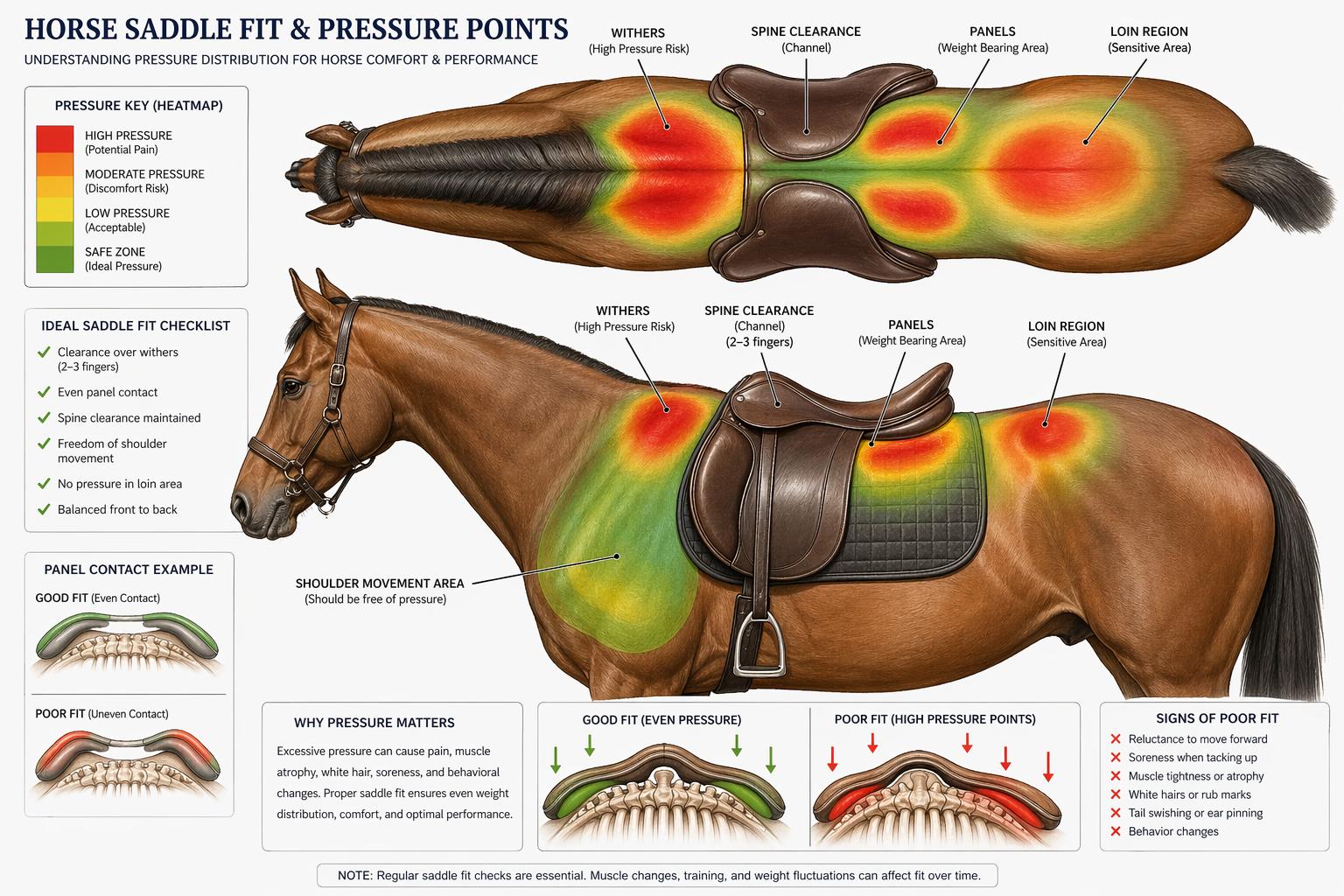
This is where our previous discussion about saddle fit becomes particularly relevant.
In If Your Horse Doesn’t Want to Go, Could It Be Your Saddle?, we talked about something that is easy to overlook:
Horse, saddle and rider function as a system.
A saddle doesn’t simply need to fit the horse.
It also needs to accommodate the rider appropriately while distributing that rider’s weight over an appropriate portion of the horse’s back.
When we’re talking about a larger rider on a smaller horse, those two requirements can begin to conflict.
The rider needs a saddle with a seat large enough to position them correctly.
The horse needs a saddle whose weight-bearing surface fits within the usable portion of its back.
A short-backed horse may simply not have room for a substantially longer saddle.
Conversely, putting the rider into a smaller saddle simply to accommodate the horse’s back isn’t necessarily a solution.
If the saddle is too small for the rider, the rider may be pushed toward the back of the seat, sit against or over the cantle, or be placed outside the saddle’s intended balance point.
That can change how pressure is transmitted to the horse.
So the question isn’t merely:
“Does my saddle fit my horse?”
It’s also:
“Can a saddle appropriately fit both my horse and me?”
Sometimes there is enough flexibility in saddle design and fitting to make that combination work beautifully.
Sometimes there isn’t.
[Read: If Your Horse Doesn’t Want to Go, Could It Be Your Saddle?]
Your Horse May Already Be Giving You Information
This brings us back to one of the central ideas from our saddle-fit article:
Behavior is information.
Horses cannot tell us that carrying a rider has become physically difficult.
Instead, they communicate through movement and behavior.
Possible signs that a horse may be struggling with some aspect of his ridden workload can include:
- Reluctance to move forward
- Slowing down without being asked
- Difficulty maintaining gait
- Frequent stumbling or tripping
- Hollowing or bracing the back
- Tail swishing
- Pinning the ears during saddling or mounting
- Moving away from the mounting block
- Difficulty with upward transitions
- Reluctance to canter
- Bucking, crow-hopping or kicking out
- Shortened stride
- Loss of topline
- Back tenderness
- Unexplained changes in attitude under saddle
- Increasing reluctance to be caught or ridden
- Taking unusually long to recover after work
And this is where we need to be careful.
None of these signs proves that the rider is too heavy for the horse.
Many of these are also signs we discussed in connection with poor saddle fit.
They can also indicate lameness, hoof imbalance, ulcers, arthritis, muscle soreness, inadequate conditioning, dental problems, training issues or other medical conditions.
The point isn’t to look at a horse who doesn’t want to canter and conclude, “The rider is too big.”
The point is to avoid looking at that same horse and immediately concluding:
“He’s lazy.”
If a horse who once willingly went forward begins telling us that riding is difficult, our responsibility is to investigate why.
Look at the Horse’s Back, Too
Just as we discussed in our saddle-fit article, your horse’s body may provide clues.
After riding, before grooming everything away, look at the saddle area.
Pay attention to:
- Repeated rubbing or broken hair
- New white hairs
- Heat or swelling
- Areas of tenderness
- Flinching or dipping when the back is touched
- Repeated dry areas surrounded by sweat
- Dramatically uneven sweat patterns
- Uneven marks on the saddle pad
- Changes in the musculature along the topline
None of these findings tells you by itself that rider weight is responsible.
But if you have a horse carrying a relatively high combined load and you’re seeing back soreness, saddle instability, behavioral changes or altered movement, the complete picture deserves attention.
The Mounting Block Matters More Than You Might Think
Mounting is another part of the equation.
When we mount from the ground, we don’t simply place our body weight gently onto the horse’s back.
We create a significant lateral and rotational force as we put weight into one stirrup and pull ourselves upward.
For a larger rider—particularly on a smaller horse—that can mean substantial movement of the saddle and force across the horse’s back.
There is a very simple way to reduce that:
Use a mounting block.
And use one that’s high enough.
Ideally, mounting should look almost uneventful. The rider should be able to step across and settle gently into the saddle rather than pulling themselves upward.
The horse shouldn’t have to brace against someone climbing onto him.
This is beneficial for virtually every horse and rider combination—not just larger riders.
Workload Changes the Equation
We also have to ask what we’re actually asking the horse to do.
A 20-minute walk around an arena isn’t the same physical demand as an hour of posting trot.
An easy ride on level ground isn’t the same as negotiating steep hills.
A quiet trail ride isn’t the same as jumping, galloping, foxhunting, endurance riding or intensive schooling.
Deep footing increases effort.
So does mud.
So do hills.
So does heat and humidity.
So does lack of fitness.
A horse carrying a challenging load through deep footing on a hot day is performing a very different physical task from that same horse walking quietly on firm, level ground for 15 minutes.
A percentage on a calculator cannot account for all of that.
“But My Horse Is Very Strong”
This is another common argument.
And your horse may indeed be very strong.
But strength isn’t exactly the same thing as suitability.
Horses are remarkably powerful animals. The fact that a horse can physically carry a person doesn’t necessarily tell us whether doing so repeatedly is comfortable or appropriate.
So perhaps the question shouldn’t be:
“Can my horse carry me?”
A better question is:
“Can my horse carry me comfortably, repeatedly and without compromising his movement or long-term soundness?”
That’s a much higher standard.
And it is probably the standard our horses deserve.
Take the Emotion Out of the Calculation
If you’re wondering whether you might be too large for your horse, start with information rather than embarrassment.
Determine your horse’s approximate weight.
Weigh yourself in your normal riding clothing.
Then weigh—or reasonably estimate—the saddle, pad and other equipment the horse carries.
Calculate:
(Rider + Tack) ÷ Horse’s Weight × 100
For example:
Horse: 850 lbs
Rider: 165 lbs
Tack: 25 lbs
Combined load: 190 lbs
190 ÷ 850 × 100 = 22.4%
Again, that number isn’t a diagnosis.
It is information.
Now use that information to evaluate the horse in front of you.
Quick Rider-to-Horse Suitability Check
Rather than relying on one percentage, ask yourself:
THE HORSE
□ Is my horse well muscled through the back and topline?
□ Is he fit for the work I’m asking him to perform?
□ Is he sound and comfortable?
□ Does his conformation appear suited to carrying my combined weight and tack?
□ Is his back relatively short and strong, or long and weak?
THE SADDLE
□ Does my saddle genuinely fit my horse?
□ Is the saddle large enough to accommodate me correctly?
□ Does it remain balanced when I’m aboard?
□ Does it stay within the appropriate weight-bearing area of my horse’s back?
□ Does it remain reasonably stable in motion?
THE RIDER
□ Can I maintain an independent, balanced seat?
□ Can I stay centered with the horse’s movement?
□ Can I mount easily from an appropriately high mounting block?
THE HORSE’S RESPONSE
□ Does my horse move freely underneath me?
□ Does he willingly move forward?
□ Does his stride remain comfortable and unrestricted?
□ Can he maintain the requested gait without continually slowing?
□ Does he recover appropriately after exercise?
□ Is his back free from tenderness after riding?
□ Does he willingly approach the mounting block and his work?
One “no” doesn’t necessarily mean you’re too large for your horse.
But a pattern of concerns deserves investigation.
Ask One More Question
There is another question that can be surprisingly useful:
If this weren’t my horse, would I think this horse and rider were appropriately matched?
Take the emotion out of it for a moment.
Imagine you’re watching this combination from the rail.
Look at the horse’s size and substance.
Look at the saddle.
Look at where the rider sits in that saddle.
Watch the horse walk and trot.
Watch the back.
Watch the stride.
Watch the transitions.
Watch whether the horse moves willingly forward.
Sometimes it’s easier to evaluate the whole picture when we mentally remove ourselves from it.
Sometimes Loving a Horse Means Not Riding Him
This may be the hardest part of the conversation.
A horse can be your favorite horse.
He can be your heart horse.
You can have owned him for years.
You can have an extraordinary relationship with him.
And it is still possible for circumstances to change.
The horse may get older.
He may lose topline.
Arthritis may develop.
His fitness may decline.
The rider’s body may change.
An injury may affect the rider’s balance.
Or perhaps the horse was always smaller than ideal, but nobody seriously considered the question before.
Choosing not to ride a particular horse doesn’t diminish your relationship with that horse.
There are many ways to enjoy horses without sitting on their backs: groundwork, liberty work, hand walking, obstacle training, long-lining, driving when appropriate, grooming, hiking together, and simply spending time with them.
And if someone wants to continue riding, the answer may be very straightforward:
It may be time for a larger or more substantial horse.
This Is a Welfare Question, Not a Body-Image Question
Conversations about rider size can become cruel very quickly.
They don’t need to.
Nobody should be mocked, photographed, shamed or humiliated because of their body.
At the same time, concern about hurting someone’s feelings cannot mean that we’re unwilling to discuss a legitimate horse-welfare question.
We routinely make decisions based on what our horses can physically tolerate.
We retire horses from jumping.
We reduce workloads for older horses.
We change saddles when their backs change.
We modify exercise programs after injuries.
We stop riding when they’re lame.
We adjust our expectations when their bodies tell us that the job has become too difficult.
Rider-to-horse suitability deserves the same thoughtful consideration.
The question isn’t:
“Is this person too big to ride?”
It’s:
“Are this rider and this horse an appropriate match for the work being asked of them?”
Those are very different questions.
Before You Call It a Training Problem, Ask Why
In our article about saddle fit, we ended with a simple idea:
When your horse’s behavior changes, ask why before automatically assuming disobedience.
The same principle applies here.
If your horse no longer wants to go forward, there are many possible explanations.
Maybe it’s the saddle.
Maybe it’s his feet.
Maybe he’s sore.
Maybe he needs conditioning.
Maybe there is an underlying medical problem.
Maybe something about the rider’s balance is making the work difficult.
And yes—sometimes the combined weight of rider and equipment relative to the individual horse may be part of the picture.
Our job isn’t to decide which answer is most comfortable for us.
Our job is to listen to the horse and investigate.
Because ultimately, your horse doesn’t know what percentage of his body weight you’re asking him to carry.
He doesn’t know the number on anyone’s scale.
He doesn’t know about the 20% rule.
He only knows how the load feels.
At Carlette Farm, we believe exceptional care begins with paying attention to the individual horse. Changes in behavior, movement and attitude are information—and our horses depend on us to listen.